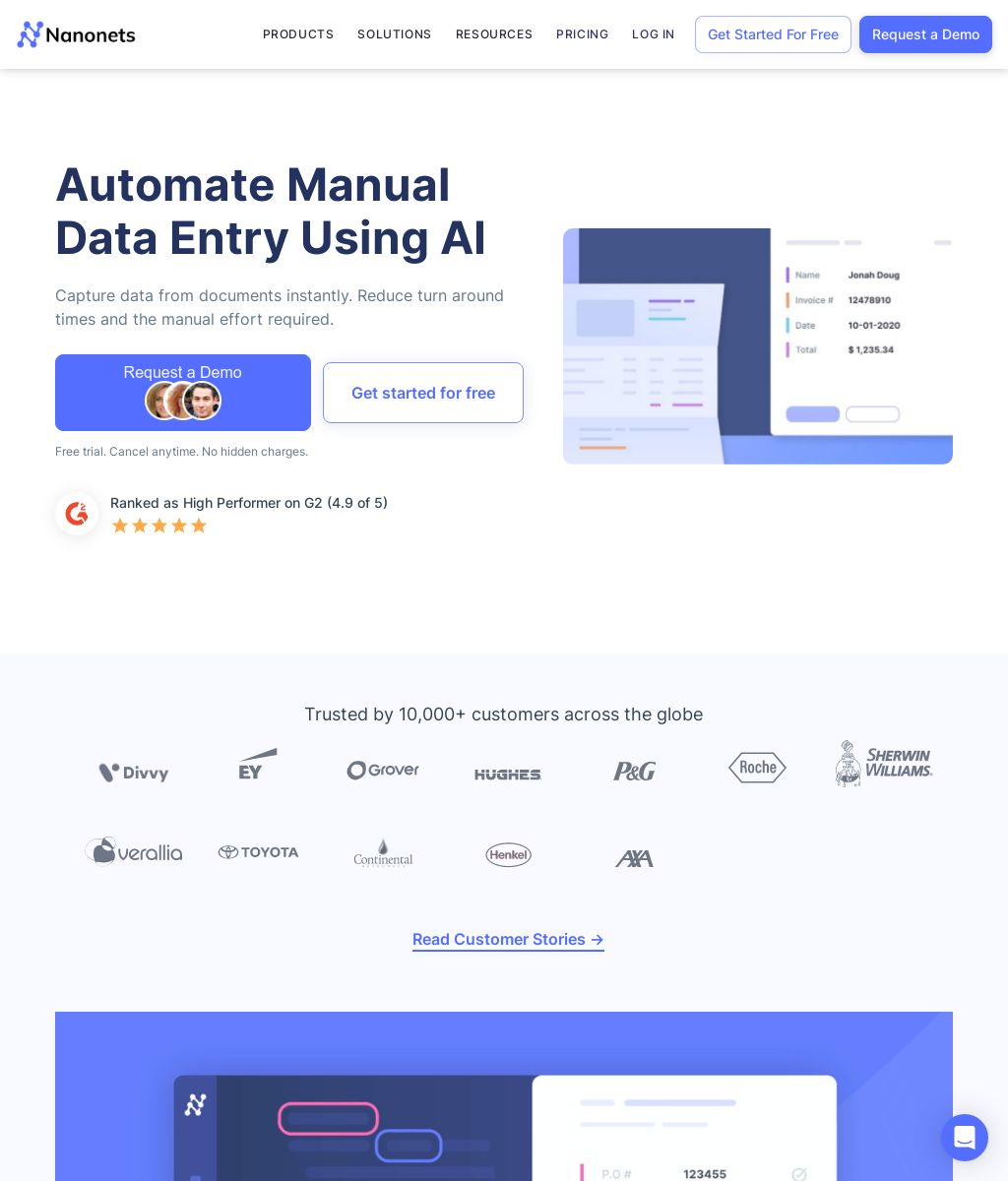
Nanonets is an enterprise-grade AI platform designed to automate data extraction from unstructured documents. Unlike basic OCR (Optical Character Recognition) that simply “reads” text, Nanonets uses deep learning to “understand” document structures, allowing it to accurately pull specific data points from invoices, receipts, ID cards, and custom forms. In 2026, it is a leader in autonomous accounting and logistics workflows, capable of processing millions of documents with minimal human intervention.
What is Nanonets?
Nanonets is a “straight-through processing” platform. It allows businesses to upload any document—even those with complex tables, blurred text, or varying formats—and instantly convert them into structured data (JSON, CSV, or XML). Its core strength lies in its self-learning capability: the more documents it processes, the more accurate it becomes at recognizing your specific business patterns. It effectively eliminates manual data entry, reducing human error and operational overhead.
Key Features of Nanonets
- AI-Powered OCR: Extracts data from hand-written notes, skewed images, and multi-page documents with high precision.
- Pre-trained Models: Ready-to-use models for common documents like invoices, passports, driver’s licenses, and purchase orders that work out of the box.
- Custom Model Training: A no-code interface that allows you to train the AI on your unique, industry-specific documents by simply “tagging” a few examples.
- Automated Workflows: Go beyond extraction by setting up validation rules (e.g., “Flag if the tax amount doesn’t match the subtotal”) and automatic approvals.
- Table Extraction: One of the market’s most robust engines for capturing complex, multi-row tables from financial statements and shipping manifests.
- Omnichannel Ingestion: Automatically pull documents from email attachments, Google Drive, Dropbox, Slack, or direct API uploads.
Why Choose Nanonets?
- Straight-Through Processing: Achieves high “touchless” rates, meaning most documents can be processed and pushed to your database without a human ever looking at them.
- Global Language Support: Seamlessly handles documents in 120+ languages, including right-to-left scripts and CJK (Chinese, Japanese, Korean) characters.
- Enterprise Security: Features GDPR, SOC 2 Type 2, and HIPAA compliance, ensuring sensitive financial and personal data is handled securely.
- Deep Integration Stack: Native connectors for Salesforce, QuickBooks, Zapier, Xero, and Sage, allowing data to flow directly into your existing ERP or CRM.
Who Should Use Nanonets?
- Accounts Payable Teams: To automate invoice processing and three-way matching, speeding up payment cycles.
- Logistics & Supply Chain Managers: To digitize bills of lading, customs forms, and delivery notes instantly.
- Financial Institutions: To automate KYC (Know Your Customer) processes by extracting data from government IDs and bank statements.
- Healthcare Administrators: To process medical claims and patient records while maintaining strict privacy standards.
Pros and Cons of Nanonets
Pros
- Superior performance on “messy” documents compared to traditional OCR tools.
- The “Self-Learning” feedback loop constantly improves accuracy over time.
- Highly scalable; handles everything from 100 to 100,000+ documents per month.
- Excellent developer documentation and API support for custom builds.
Cons
- Initial setup for highly complex, non-standard documents can require some “tuning” of the AI.
- The feature-rich nature of the platform may be “overkill” for individuals looking for a simple PDF converter.
- Premium features and high-volume processing require enterprise-level pricing tiers.
Final Wording for Nanonets
Nanonets is the premier choice for organizations that want to “delete” manual data entry from their operations. It transforms the friction of paperwork into a fluid, digital data stream. By giving businesses the power to see and understand their data in real-time, Nanonets enables faster decision-making and unprecedented operational efficiency. In 2026, it is the definitive engine for the paperless, autonomous enterprise.